Honoring the Apollo 11 Legacy: Lunar Receiving Park Opens at Johnson Space Center with Oklahoma Ties
History and innovation meet at the newly completed Lunar Receiving Park at Johnson Space Center in Houston, Texas, a space designed to commemorate one of the most remarkable chapters in human exploration.
The park honors the legacy of Building 37, which once housed critical operations supporting the historic Apollo 11 mission. From this facility, the team behind humanity’s first journey to the Moon coordinated efforts that ultimately placed the first astronauts on the lunar surface. The people who worked in this facility helped make it possible to get the first man on the moon.
Although Building 37 no longer stands, its impact on space exploration remains profound. The building housed the Lunar Receiving Laboratory, where scientists carefully studied the first samples returned from the Moon. Their work ensured those materials were safe for Earth while advancing scientific understanding of our nearest celestial neighbor.
Designing a Space That Preserves History
When planning the new park, the project team shared a clear goal: to create a meaningful space that honors the dedication, innovation, and courage of the individuals behind the Apollo 11 mission.
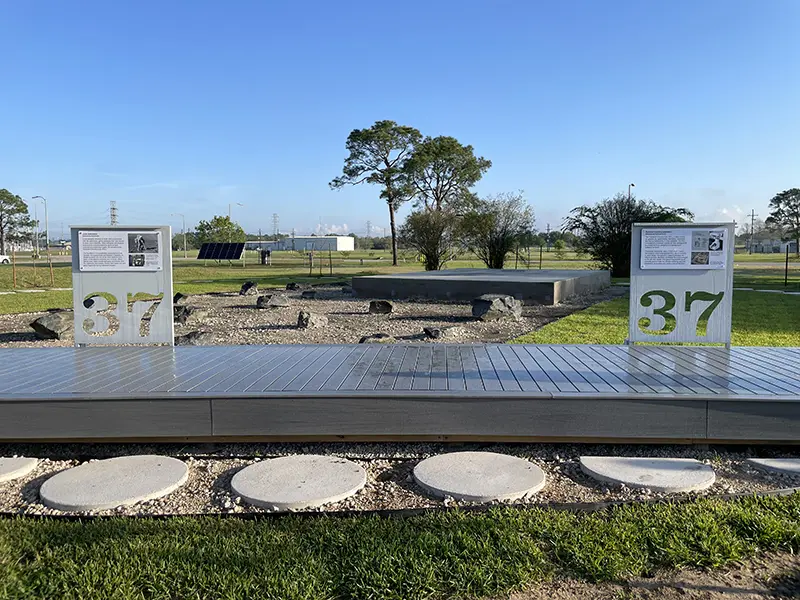
Lunar Receiving Park invites visitors to explore that history in an immersive way. A looping pathway guides guests through the site, where artifacts and interpretive features tell the story of the work that once took place there. The park’s design subtly reflects an archaeological dig, with varying elevations throughout the pathway suggesting layers of discovery. Visitors will also notice “footprints” and remnants integrated into the landscape, symbolic touches that connect the site’s past to the present.
At one point on the loop, visitors can see a white “cap” visible on the ground. This “cap” is the top of a 60-foot underground chamber, which was the original receiving laboratory the Apollo 11 team used to evaluate the specimens they received from the moon to “protect” Earth from any possible contaminants that could come back with the lunar samples,” said Bob McCombs, Guernsey Design Manager.
Some elements of the original facility were incorporated directly into the design. Most notably, the original loading bay doors from Building 37, through which the Apollo 11 astronauts and the first lunar samples entered, now stand at the park's entrance, creating a powerful physical link to history. The original loading bay doors required additional structural engineering support from Kasha Egan, a Guernsey structural engineer. She ensured the salvaged steel framework and foundation were durable and well-preserved.
“One of my favorite things about this project was the opportunity to work with NASA and help create a space they were truly proud of. It’s the kind of project that resonated not just professionally, but personally. My family was just as excited about it as I was,” said Kasha.
Sustainable Design with Lasting Impact
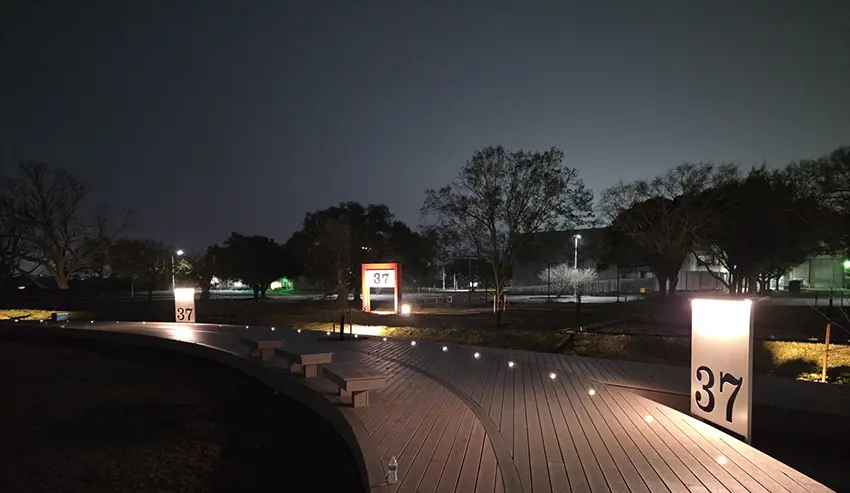
Beyond honoring the past, the park was designed with the future in mind. Evening lighting illuminates the space for visitors while being powered by solar panels, demonstrating how modern infrastructure can support both sustainability and storytelling.
The $1.2 million project reflects a collaborative effort between design and construction teams committed to preserving this important piece of space exploration history. The design team developed a concept that conveyed the site's significance while remaining constructible within the budget.
A Collaborative Effort
Guernsey was proud to support the project as part of the design-build team, providing civil, electrical, and structural engineering services to help bring the Lunar Receiving Park to life. “My favorite part about this project was being involved with the inner workings of NASA, and learning about the historical significance of this building and the rest of the Johnson Space Center,” said Bob McCombs.
Guernsey’s project team included:
- Bob McCombs: Design Manager, Design-Build Partnership
- Darby Anderson: Senior Civil Engineer
- Kasha Egan: Structural Engineer
- Rabie Taha: Electrical Engineer
- Sean Wright: Senior Electrical Engineer
Project partners included:
- Ayuda Construction
- Butzer Architects and Urbanism
Now Part of the NASA Experience
Following the ribbon-cutting ceremony on March 25, 2026, Lunar Receiving Park officially opened at NASA’s Johnson Space Center in Houston. The park is now included in NASA’s guided tram tours, allowing visitors from around the world to experience this tribute to one of humanity’s greatest achievements.
By preserving the legacy of Building 37 while creating a new educational and reflective space, Lunar Receiving Park ensures that the story of the Apollo 11 era, and the people who made it possible, continues to inspire future generations of interstellar curiosity. “It was inspiring to be part of a project that honors such an important legacy while also looking toward the future,” said Kasha Egan.
On April 1, 2026, Artemis II was launched into space to perform a figure-8 around the moon, and then on splashdown in the Pacific Ocean on Day 10. The Lunar Receiving Park at the Johnson Space Center will be used for the astronauts' homecoming celebration,