Make Better Infrastructure Decisions Before You Spend the Money
Most infrastructure costs are decided before construction ever begins.
They are set by assumptions no one revisits.
Guernsey helps organizations challenge those assumptions—before they become capital commitments. We provide energy and utility optimization services that evaluate infrastructure systems, identify cost avoidance, and support capital decision-making.
This approach has supported the Department of Defense in identifying $4.86+ billion in potential cost avoidance over 40 years through system-level infrastructure decisions.
This is not about incremental efficiency. It is about deciding what the system should be.
- Re-Evaluating Existing Systems Assess current infrastructure and planned investments to prevent unnecessary capital spending
- Cost Avoidance at Scale Identify and prevent unnecessary infrastructure investment, not just reduce operating cost
- System-Level Visibility Connect assets, condition, performance, and cost into a complete, usable system view
- Performance Under Real Conditions Account for operational constraints, reliability risk, and long-term cost exposure from the outset
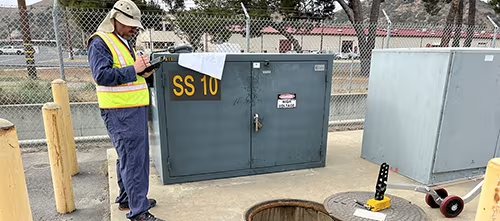
Guernsey’s team provides on-site support for Utility Inventory & Condition Assessment Programs, Utility Privatization and more.
The Risk Isn’t the System. It’s the Assumptions Behind It.
Most infrastructure decisions follow a familiar pattern:
- Replace assets based on age
- Expand systems based on projected demand
- Maintain what exists without fully understanding condition
It feels disciplined. It is often misaligned with reality.
Your team sees this directly in the field. Systems are often replaced on lifecycle timelines, even when condition does not require it. That is how unnecessary capital spending gets locked in; and why better data alone is not enough.
The decision framework has to change.
Proven at Federal Scale
Guernsey’s work across Department of Defense installations has identified $4.86+ billion in potential cost avoidance over 40 years through system-level infrastructure decisions—not incremental efficiency improvements.
These outcomes are based on real installations and reflect avoided capital investment, deferred replacement, and reconfigured system strategies.
They include:
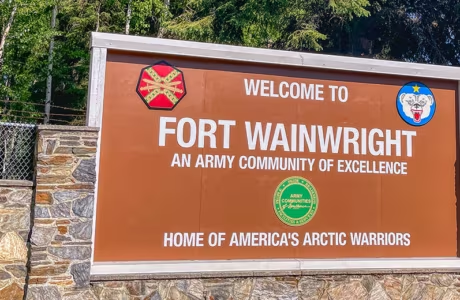
- $3+ billion identified by restructuring district energy systems at Fort Wainwright and Fort Greely
- $463 million in projected savings over 25 years through evaluation of a resource-based generation strategy at Kwajalein Atoll
Avoided cost is often more valuable than realized savings because it prevents unnecessary capital from being committed in the first place.
This work does not optimize existing systems. It determines whether those systems should exist as designed.

Kwajalein Atoll: When the System Has to Be Right
At Kwajalein Atoll, energy decisions are constrained by location, logistics, and long-term dependence on delivered fuel; creating sustained cost exposure over time.

Guernsey evaluated the existing system and modeled alternative approaches based on:
- Site-specific resource availability
- System performance and reliability
- Long-term cost exposure
The outcome was not a system upgrade.
It was a redefinition of how power could be generated and sustained over time, resulting in:- $463 million in projected lifecycle savings
- Reduced long-term fuel dependency
- A system strategy aligned with operational realities
Not a better version of the same system. A different path forward.
University Energy & Utility Advisory
Universities are making long-term utility decisions under pressure: aging infrastructure, rising costs, capital constraints, and increasing scrutiny around how systems are owned, operated, and funded. The wrong decision locks in cost, risk, and operational limitations for decades.
Guernsey supports universities before those commitments are made. We assess existing systems, define real capital needs, evaluate sourcing and delivery options, and provide the technical and financial analysis required to make informed decisions. The focus is not design. It is decision clarity.

When Universities Bring Us In
- When campus utility systems need to be evaluated for condition, capacity, and remaining life
- When leadership needs a cost of service study and defensible internal rate structure
- When a university is evaluating alternative utility service models or outside provision
- When major upgrades or capital investments need validation before funding decisions
- When performance contracting or other delivery options require a clear business case
- When procurement, contract structure, and long-term performance measures need to be defined
What We Do
Utility System Assessment
Inventory and evaluate electric, thermal, and natural gas systems to understand condition, capacity, and risk.
Cost of Service & Rate Analysis
Develop cost of service studies and rate structures that reflect actual system cost and support internal decision-making.
Strategic Sourcing Studies
Evaluate service delivery options, including long-term operations, maintenance, and capital responsibility.
Life-Cycle Cost & Capital Planning
Model long-term capital needs, useful life, and total cost of ownership across multiple scenarios.
Business Case Development
Compare alternatives using technical, financial, and operational criteria to support executive-level decisions.
Procurement & Implementation
Assist with procurement strategy, documentation, and coordination with financial and legal advisors.
Post-Award Oversight
Support performance tracking and alignment after implementation to ensure commitments are met.
 University of Alabama
Utility System Assessment and Cost of Service Study
Assessment of electric, natural gas, and thermal systems to define system condition and long-term needs. Development of a 50-year life-cycle cost analysis, annual expenditure projections, and utility rate recommendations for internal campus users.
 Multiple Universities
University Strategic Sourcing Studies
Support for multiple institutions including the University of Oklahoma, Oklahoma State University, Purdue University, and the University of Kansas. Work includes O&M and capital forecasting, useful life analysis, ECM savings verification, private-sector comparator modeling, business case development, procurement documentation, and coordination with financial and legal teams.
How We Approach University Energy & Utility Work
- Assess existing systems and establish a reliable technical baseline
- Define requirements, constraints, and capital needs
- Develop and compare viable delivery and improvement alternatives
- Evaluate life-cycle cost, risk, and operational impact
- Support procurement, negotiation, and implementation
- Provide oversight to maintain alignment after decisions are executed
One Decision Framework. Multiple Disciplines.
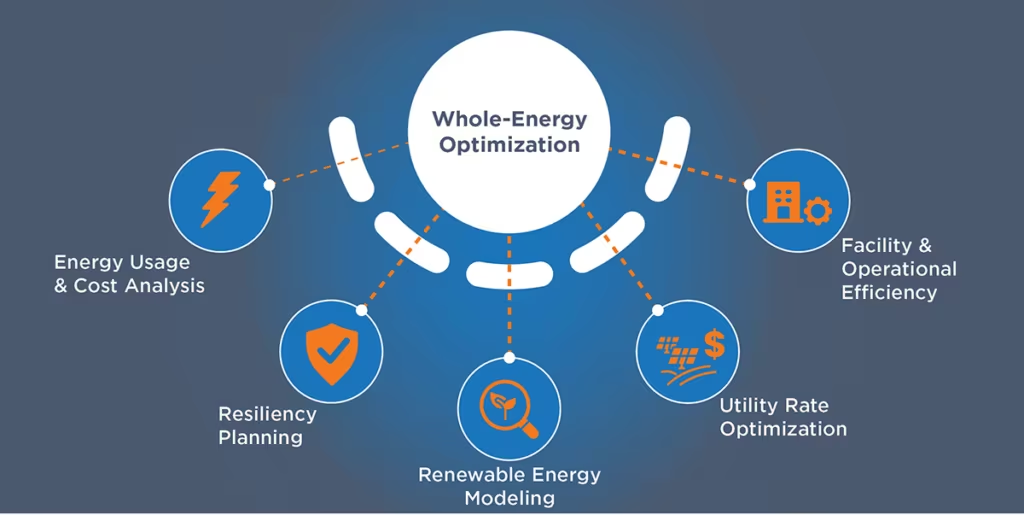
Guernsey’s work brings together what are often treated as separate services into a single decision process.
Utility Assessment
Build a complete, usable system view—even when data is incomplete, fragmented, or analog BrochureCost Avoidance
Identify where capital spending is unnecessary, mistimed, or misaligned before it is committed BrochureResilience & Reliability
Evaluate how systems perform under disruption, failure, and change to support operational continuity BrochureWhole Energy Strategy
Align infrastructure, operations, and cost into a long-term, mission-aligned system strategy BrochureThese are not separate efforts.
They are components of one outcome: better infrastructure decisions.
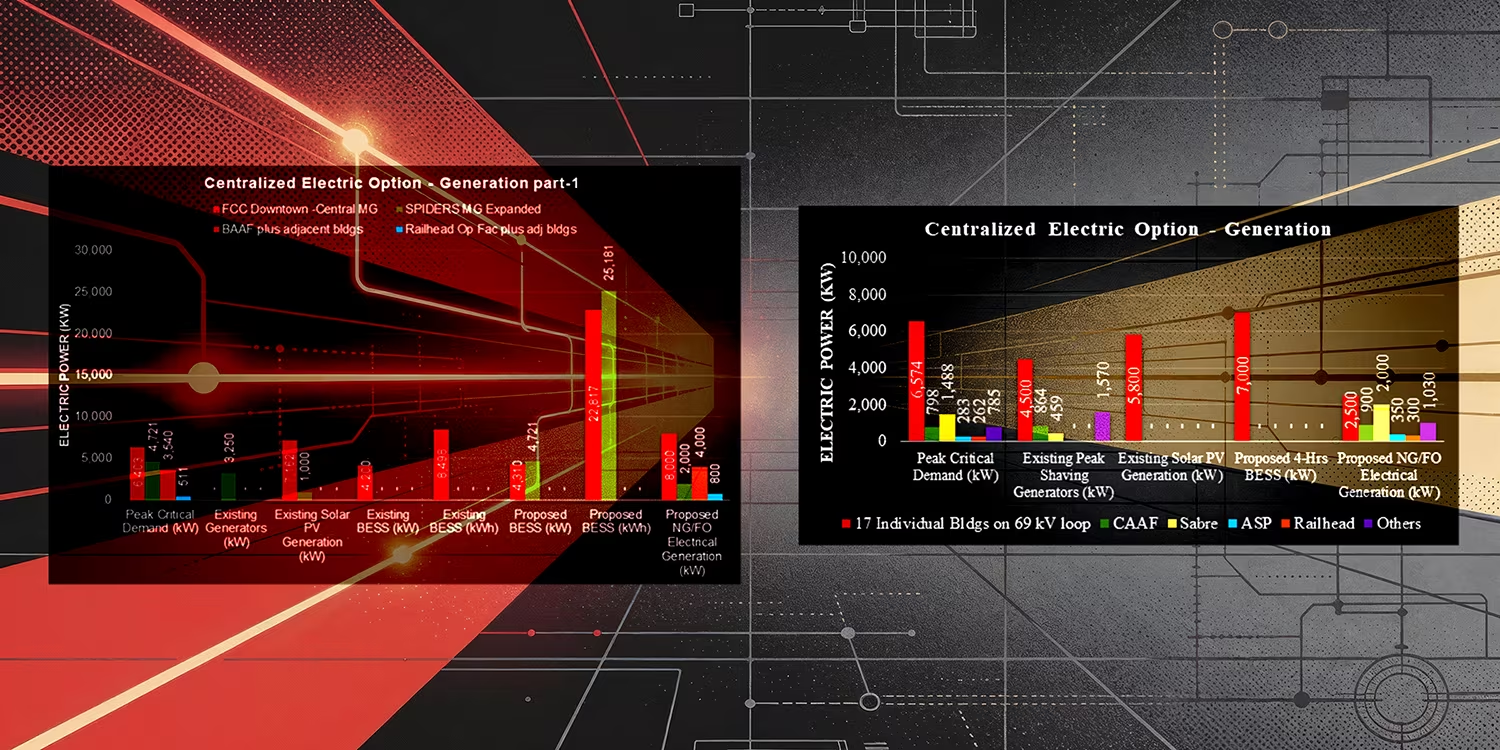
Guernsey provides data-driven insights, including life-cycle cost analysis and cost scenario modeling.
From Data to Decisions
Guernsey connects system reality, performance, and cost into a single view that supports action.
- Build the System View Digitize legacy records, integrate field data, and create a reliable system of record. This work is supported by integrated GIS, field data collection, and system modeling that create a complete, usable system of record.
- Understand Condition and Performance Assess infrastructure condition and map how the system actually operates
- Connect to Cost and Timing Model lifecycle cost and prioritize investments based on condition—not assumption
- Deliver Decision Clarity Provide clear, visual outputs that support leadership-level decisions
Where This Applies
Federal & DoD Installations
Mission-critical infrastructure, remote operations, and long-term energy security requirements where system failure or misalignment carries operational risk.
Universities & Campus Systems
Central plants, distributed utilities, and campus-wide infrastructure where cost of service, capital planning, and sourcing decisions impact long-term financial and operational performance.
Electric Utilities & Cooperatives
Generation, distribution, and system planning decisions influenced by load growth, regulatory pressure, and long-range capital investment needs.
Municipal & Public Infrastructure
Water, wastewater, and community systems where funding constraints, aging infrastructure, and service reliability must be balanced.
Large-Scale Industrial & Institutional Facilities
Complex facilities with high energy demand, specialized systems, and operational requirements that require coordinated, cross-disciplinary evaluation.
Different systems. Same problem: decisions are often made based on incomplete assumptions. The approach remains consistent. Define the system, evaluate the options, and make the right decision before capital is committed.
Mission-Aligned Energy Strategy for Complex Organizations
What Clients Gain
- A complete, usable view of their system
- Identification of what actually requires investment
- Reduced unnecessary capital spending
- Prioritized, defensible funding decisions
- Improved reliability and long-term performance
Capital goes where it is needed—not where it has always gone.
Most importantly:
Confidence that capital decisions are based on reality—not assumption.
Guernsey’s approach is defined by independent analysis, no predetermined outcomes, and the ability to connect technical findings to board-level decisions.
Most firms optimize within existing systems. Guernsey evaluates whether those systems should exist as designed.
Start with the Right Question
If infrastructure decisions are being made based on age, assumption, or incomplete data, the risk is already built in.
Then decide what the system should be.
Request a System EvaluationFAQs
Most organizations evaluate systems after a failure or when replacement is already planned. By that point, major decisions have already been made.
This work is most valuable before capital planning, system expansion, or major upgrades—when assumptions can still be challenged. It is also critical when infrastructure data is incomplete, fragmented, or outdated, and decisions are being made without a clear understanding of system condition, performance, and cost.
Unnecessary capital spending is often driven by assumptions—replacing assets based on age, expanding systems based on projections, or maintaining infrastructure without understanding condition.
Guernsey connects field data, system performance, and lifecycle cost modeling to evaluate what actually requires investment. This includes condition assessments, consequence and likelihood of failure, and scenario modeling to determine where capital can be deferred, avoided, or reallocated based on real system needs.
Cost avoidance is the prevention of unnecessary capital investment before it is committed.
Rather than optimizing within an existing system, this work evaluates whether that system should exist as designed. Through system-level analysis, lifecycle cost evaluation, and alternative modeling, Guernsey identifies where infrastructure can be reconfigured, deferred, or eliminated.
This approach has supported the Department of Defense in identifying billions in potential long-term cost avoidance through strategic infrastructure decisions.
Most capital decisions are made without a complete understanding of existing systems.
This work is typically performed when data is incomplete, systems are aging, or capital planning decisions need to be based on actual condition rather than assumption.
Guernsey combines field data collection, GIS integration, and system analysis to build a complete picture of infrastructure condition. This includes component-level inventory, age, remaining service life, and identification of vulnerabilities across generation, distribution, and collection systems.
Assessments support lifecycle cost analysis, consequence and likelihood of failure, and risk-based capital planning. The result is a defensible basis for prioritizing investment, reducing unnecessary replacement, and extending system life.
Most energy models simplify reality. That is where decisions start to break down.
This work typically occurs when organizations need to understand the true cost of energy across purchased and self-generated sources, or when evaluating system changes before capital is committed.
Guernsey develops custom models based on how systems actually operate. This includes energy usage profiling, lifecycle cost analysis, and cost scenario modeling. Our proprietary MATLAB-based COEISA model has been used to evaluate the optimal mix of purchased and on-site generation to reduce cost and meet energy security goals. Additional modeling supports energy storage sizing, load shifting, demand management, and cogeneration optimization.
At one Army installation, this approach identified more than $4 million in potential annual savings by using existing generation assets to control peak demand.
Energy systems are not just infrastructure. They determine whether operations continue under stress.
This becomes critical when outages, supply disruptions, or cyber threats expose gaps in how systems actually perform.
We evaluate onsite generation, determine critical loads, and assess system performance under real conditions. That includes identifying true cost exposure, analyzing rate structures, and improving preparedness for disruption. The result is a clearer understanding of what is required to maintain operational continuity when conditions change.
Evaluation of existing electric, thermal, and gas systems to document condition, capacity, remaining life, and risk, forming the basis for capital and operational decisions.
An analysis of the true cost to operate and maintain campus utility systems, used to establish internal rates and support funding decisions.
By comparing technical performance, life-cycle cost, operational responsibility, and risk across multiple delivery models, including development of private-sector comparator analyses.
A financial and operational model used to evaluate how a third-party delivery approach would perform relative to current or alternative structures.
It projects long-term capital, operations, and maintenance costs, allowing universities to compare options based on total cost of ownership rather than initial cost alone.
Guidance on procurement strategy, documentation, and coordination with advisors, followed by post-award oversight to track performance and maintain alignment with the original business case.