
The Biggest Proposed Changes to Federal Grant Administration in More Than a Decade


By Angie Aikman, CIE, CSM, Vice President and Design Group Director, Environmental
A proposed federal rule could significantly change how grant recipients document expenses, monitor subrecipients, and maintain eligibility for federal funding.
For organizations already balancing grant administration responsibilities across finance staff, project managers, engineers, administrators, and consultants, the proposed changes could increase compliance responsibilities at a time when federal funding opportunities remain substantial.
On May 29, 2026, the Office of Management and Budget (OMB) published a proposed rule to revise the federal government’s grant management framework for grants, cooperative agreements, and other forms of federal financial assistance.1 The proposal is not final, and some provisions may change before implementation. However, it provides an important indication of where federal grant administration may be heading: increased oversight, greater accountability, and closer scrutiny of how federal funds are managed.
Why This Matters
For many organizations, winning a grant is only the beginning.
The work that follows often includes procurement requirements, reimbursement requests, documentation standards, subrecipient monitoring, financial reporting, and audit preparation. Most organizations do not maintain large internal teams dedicated solely to federal grant administration. Those responsibilities are frequently distributed across employees already managing numerous other priorities.
The proposed rule suggests that those responsibilities may continue to grow.
Organizations with limited administrative capacity could face:
- Additional documentation requirements
- Increased oversight responsibilities
- Greater emphasis on internal controls
- More scrutiny of payment requests
- Increased consequences for compliance failures
Strong grant administration practices have become an operational necessity rather than an administrative afterthought.
The Uniform Guidance Would Become a Uniform Grants Regulation
One of the most important proposed changes is structural.
OMB proposes to clarify that the government-wide requirements in 2 CFR subtitle A would operate as an OMB regulation rather than solely as guidance.2 The stated goal is to create greater consistency, transparency, and predictability across federal agencies.
That may sound administrative. It is not.
If finalized, future OMB amendments to the government-wide grant rules would apply across agencies on OMB’s effective date without requiring separate agency rulemaking to restate the same requirements.3
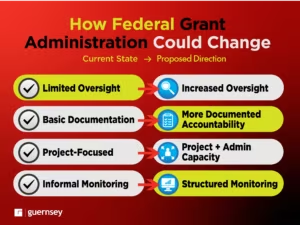
For grant recipients, the practical lesson is straightforward. Federal grant requirements are becoming more centralized, more formal, and more important to monitor.
Federal Agencies Would Have Broader Termination and Suspension Tools
OMB also proposes revisions to 2 CFR § 200.340, the section governing termination and suspension of federal awards.
The proposed rule would clarify reasons available to federal agencies for discretionary termination of federal awards and add new provisions related to temporary suspension.4 OMB explains that the proposal would preserve agency flexibility when program goals, agency priorities, or federal interests change after an award is made.5
The proposal also would require agencies to inform recipients of the termination provisions in § 200.340, either directly in the award or by reference.6
For recipients, this raises the stakes for ongoing compliance and documentation.
Receiving the award is not the finish line.
Project records, reimbursement documentation, procurement files, and decision histories all matter long after funding is awarded.
Applicant Risk Reviews Would Expand
OMB proposes revisions to 2 CFR § 200.206, which governs federal agency review of risk posed by applicants.
The proposed changes would expand the factors agencies may consider when evaluating applicant risk, including financial capacity, prior performance, audit reports, management systems, and other indicators of organizational readiness.7
This matters because grant readiness is no longer only about having an eligible project.
Applicants may increasingly need to demonstrate that they have the systems, controls, and administrative capacity necessary to manage federal funds responsibly.
For smaller public entities, special districts, Tribes, cooperatives, and nonprofits, this can become a practical staffing and resource issue. A worthwhile project can still create risk if the administrative structure behind it is weak.
Payment Requests Would Face Additional Verification and Justification Requirements
OMB proposes revisions to 2 CFR § 200.305, the federal payment section.
Under the proposal, federal agencies would verify recipient eligibility through the Treasury Department’s Do Not Pay system before making federal disbursements. OMB also proposes language requiring payment requests from recipients and subrecipients, other than states, to include justifications describing the purpose of the payment and the specific award-related work it supports once appropriate systems are in place.8
Administrative requirements that appear minor on paper can have real consequences for project schedules and cash flow.
Reimbursement requests already require coordination among project managers, finance teams, consultants, contractors, and grant administrators. If additional payment justification requirements become final, weak documentation practices could slow payments, increase staff burden, and create avoidable compliance risk.
Pass-Through Entities Would Face Clearer Subaward Reporting Responsibilities
OMB proposes changes to 2 CFR §§ 200.329 through 200.332 related to subaward reporting and pass-through entity responsibilities.
The proposal states that pass-through entities must report subawards on SAM.gov in accordance with 2 CFR part 170 and make subrecipient or contractor determinations for downstream entities receiving payments, including affiliates, subsidiaries, or other related organizations.9
The proposed rule also states that failure to report subawards on SAM.gov pursuant to the award term required by 2 CFR part 170 can constitute grounds for termination for noncompliance.10
Subrecipient monitoring cannot be informal.
An undocumented determination that seems insignificant today can become an audit finding years after the project is complete.
The classification, reporting, documentation, and follow-up need to be deliberate and defensible.
Federal Award Reviews Would Receive Greater Senior-Level Scrutiny
OMB proposes revisions to 2 CFR § 200.205, the federal agency merit review section.
The proposed rule would establish a new pre-issuance review process for certain discretionary awards and require agencies to ensure that proposals selected for funding are consistent with applicable law, federal agency priorities, and the national interest.11
For applicants, this reinforces the importance of project clarity.
Applications should make the project need, public benefit, administrative capacity, and implementation plan easy to understand. Strong projects should not rely on reviewers to connect the dots.
What Could This Mean in Practice?
Although the proposed rule is not final, organizations may want to consider how these changes could affect their grant administration practices.
| Proposed Change | Potential Impact |
|---|---|
| Expanded applicant risk reviews | More documentation demonstrating organizational readiness and internal controls |
| Additional payment justification requirements | Increased administrative work supporting reimbursement requests |
| Enhanced subaward reporting requirements | More structured monitoring and documentation responsibilities |
| Expanded termination and suspension authorities | Greater importance of maintaining complete and defensible project records |
| Increased federal oversight | More emphasis on policies, procedures, and grant administration capacity |
What Grant Recipients Should Be Asking Now
Although the proposal is not final, organizations that wait until new requirements become effective may find themselves updating policies, training staff, and reorganizing project documentation under compressed timelines.
Evaluating grant administration practices now can make future transitions considerably easier.
Questions worth asking include:
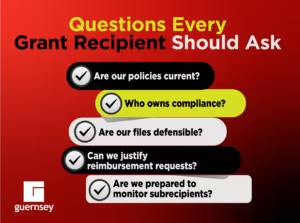
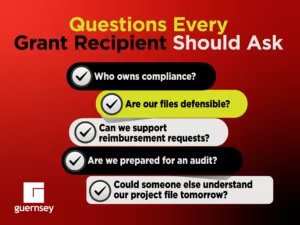
- Who is responsible for grant compliance within our organization?
- Are our policies and procedures current?
- Can we support each reimbursement request with complete documentation?
- Are subrecipient files organized and defensible?
- Do we have a process for monitoring federal regulatory changes?
- Can we demonstrate administrative capacity before, during, and after award?
These questions are not theoretical.
They often determine whether a project moves forward smoothly or becomes difficult to administer after funding is awarded.
Looking Ahead
The proposed revisions are still moving through the federal rulemaking process, and the final regulations may differ from what OMB has proposed. Comments are due July 13, 2026.12
Still, the direction is clear.
Federal grant administration is becoming more formal, more closely reviewed, and more dependent on strong internal systems.
Organizations that prepare now will be better positioned to protect funding, maintain compliance, and keep critical projects moving.
Waiting until a payment issue, audit finding, or subrecipient problem appears is often the most expensive time to discover that grant administration matters.
About the Author
Angela Aikman serves as Vice President and Director of Environmental Services at Guernsey, where she also leads the firm’s growing Grant Administration Services practice. With more than 25 years of experience managing environmental compliance, federal permitting, and complex infrastructure projects, she has helped public agencies, Tribal governments, utilities, and private organizations navigate the regulatory and administrative requirements that accompany federally funded projects. Her work spans environmental planning, agency coordination, compliance management, and grant-supported project delivery, giving her a practical understanding of the challenges organizations face after funding is awarded. Angie is passionate about helping clients build the systems, processes, and partnerships needed to successfully manage federal grants from award through closeout.
Notes
- Office of Management and Budget, Regulation for Federal Financial Assistance, Federal Register, Vol. 91, No. 103, May 29, 2026.
- Proposed revisions regarding the regulatory status of 2 CFR subtitle A.
- Proposed treatment of future amendments to government-wide grant regulations.
- Proposed revisions to 2 CFR § 200.340, “Termination and Suspension.”
- Discussion of expanded agency termination authorities.
- Proposed revisions to 2 CFR § 200.211(c)(1)(v).
- Proposed revisions to 2 CFR § 200.206, “Federal agency review of risk posed by applicants.”
- Proposed revisions to 2 CFR § 200.305, “Federal payment.”
- Proposed revisions to 2 CFR § 200.332 and 2 CFR part 170.
- Proposed revisions to 2 CFR § 200.205, “Federal agency review of merit of proposals.”
- Office of Management and Budget. Guidance for Federal Financial Assistance, Final Rule, April 22, 2024.
- Federal Register notice, Regulation for Federal Financial Assistance, May 29, 2026 (comment deadline).