FAA’s VPAR Takes Shape at MMAC—with Guernsey Helping Design the Future of AAM


The future of flight is taking shape at the FAA’s Mike Monroney Aeronautical Center (MMAC) in Oklahoma City, with Guernsey designing the infrastructure needed to bring it to life.
During a recent presentation at the AAAE Airport Operations and Technology Symposium, Chad Nimmo, P.E., Deputy Division Manager with the Architecture and Engineering Division at MMAC, highlighted the major initiative underway: the FAA’s new VTOL Procedures and Analysis Range (VPAR).
Throughout his presentation, Nimmo repeatedly highlighted Guernsey’s role in advancing VPAR from an emerging concept to a physical testing environment designed to support the future of Advanced Air Mobility (AAM).
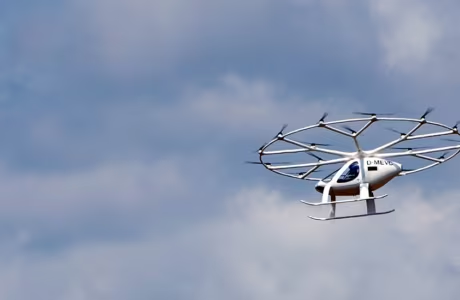
For MMAC, VPAR represents more than another construction project. It expands the Center’s ability to help the FAA understand, test, and ultimately establish the procedures necessary to safely integrate a new generation of verticraft into the National Airspace System.
From an Unfamiliar Idea to a New FAA Capability
Nimmo traced the project’s origins to 2021, when the FAA, in collaboration with NASA, began exploring how the Aeronautical Center could contribute to the rapidly evolving fields of unmanned aircraft systems and Advanced Air Mobility.
As Nimmo recalled, the concept was initially well outside MMAC’s traditional facilities mission.
“We train our air traffic controllers, we maintain NAS equipment,” he said of his initial reaction. “We don’t fly drones.”
But the Aeronautical Center’s potential as a testing environment quickly became apparent.
Rather than searching for the easiest possible location, Nimmo and the team began identifying the very conditions that could complicate future AAM operations—from congested areas and security considerations to critical infrastructure, radar systems, and radio-frequency interference.
MMAC offered those challenges in abundance. The campus includes approximately 130 buildings, thousands of people, and infrastructure critical to the National Airspace System, all within a secure facility near a major urban area.
Those challenges ultimately became part of the opportunity.
Future AAM operations will have to coexist with buildings, people, conventional aircraft, communication systems, security requirements, and existing infrastructure. MMAC provides the FAA with an environment in which those interactions can be studied under realistic conditions.
Turning the Concept into VPAR
That early work ultimately evolved into VPAR (VTOL Procedures and Analysis Range).
Nimmo described its beginnings as intentionally modest: two vertiport parking areas connected by a VTOL-capable taxiway, a shelter, and an observation and control facility.
“Humble beginnings,” Nimmo told the audience, adding an important reminder: “Almost everything starts off from humble beginnings.”
The physical footprint may be relatively small, but the mission is not.
As Nimmo walked the audience through VPAR’s evolution, from concept and funding to design and construction, he referenced Guernsey multiple times, underscoring the firm’s role in translating the FAA’s operational vision into a functioning test facility.
Guernsey’s work extends beyond designing a place for verticraft to land. The team has worked with the FAA to translate evolving operational concepts into buildable infrastructure, addressing aircraft movement, site development, supporting facilities, utilities, safety, and security while preserving the flexibility necessary for an emerging technology.
From the outset, Guernsey assembled a multidisciplinary team of architects, engineers, cybersecurity consultants, and utility optimization analysts to create an adaptable, forward-looking environment designed to help shape the future of personal vertical flight.
Guernsey: Designing What Happens on the Ground
Advanced Air Mobility naturally draws attention to what happens in the air. Making it viable at scale, however, will depend just as much on what happens on the ground.
Verticraft will need places to land, taxi, stage, and operate. Those facilities must connect to existing infrastructure, operate safely in complex environments, and adapt as vehicles and operating requirements change.
VPAR is helping turn those questions into something the FAA can physically test, evaluate, and learn from.
Guernsey’s design is now under construction at MMAC, with completion expected in August 2027.