Improving Road Safety with Roundabouts


Contrary to intuition, roundabouts are a remarkably safe intersection design that effectively safeguards drivers and pedestrians. Not surprisingly, the Federal Highway Administration (FHWA), the Insurance Institute for Highway Safety (IIHS), and the Oklahoma Department of Transportation (345) (ODOT) all advocate for the increased use of roundabouts in roadway design.
Studies have consistently shown a significant reduction in the number and severity of accidents at roundabouts compared to traditional stop-controlled or signalized intersections, including the National Cooperative Highway Research Program (NCHRP) Report 572: “Roundabouts in the United States“.
FHWA’s Proven Safety Countermeasures initiative (PSCi) includes roundabouts in its recommendations. Per the FHWA website, “These strategies are designed for all road users and all kinds of roads—from rural to urban, from high-volume freeways to less traveled two-lane State and county roads, from signalized crossings to horizontal curves, and everything in between.”
“…injury and fatal crashes can be reduced 20 percent for traffic flows of double-lane roundabouts with approximately 40,000 average daily traffic (ADT), and by as much as 70 percent for traffic flows of single-lane roundabouts up to 20,000 ADT.” – Reducing Points of Conflict, FHWA.
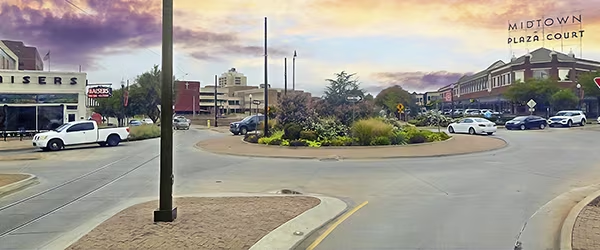
Key design safety elements of a well-designed roundabout
Unlike stop-controlled intersections, roundabouts promote a continuous traffic flow, reducing the need for complete stops. The geometry of the roundabout forces drivers to reduce speed while yielding to oncoming traffic and to continue at similar, slower speeds within the roundabout. Entry widths give roadway designers control over traffic volumes within the roundabout.
The design of roundabout entries minimizes the number of “conflict points” where vehicles, cyclists, or pedestrians intersect. Fewer conflict points constitute a significant advantage of roundabouts. Per the FHWA, “a single-lane roundabout has 50% fewer pedestrian-vehicle conflict points than a comparable stop or signal-controlled intersection. Conflicts between bicycles and vehicles are reduced as well.”
Transportation engineers can further protect pedestrians by leveraging the splitter island between entry and exit lanes to reduce distances across roadways pedestrians travel. These reduced distances, slower traffic speeds, and vehicles traveling in only one direction make crossings simpler and safer for pedestrians and drivers.
The Beauty of Roundabout Design
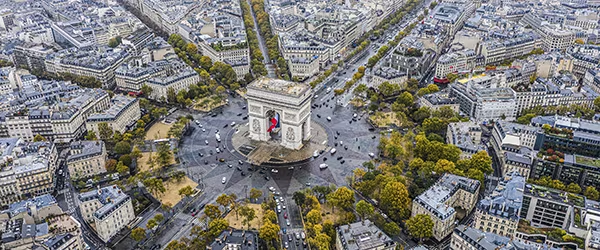
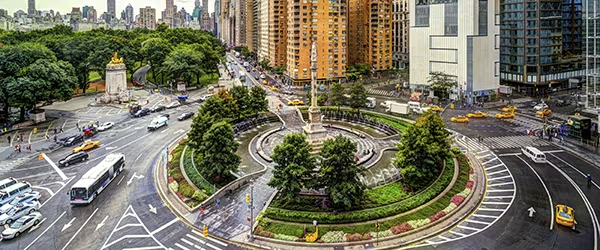
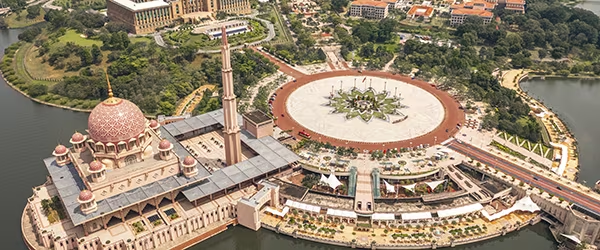
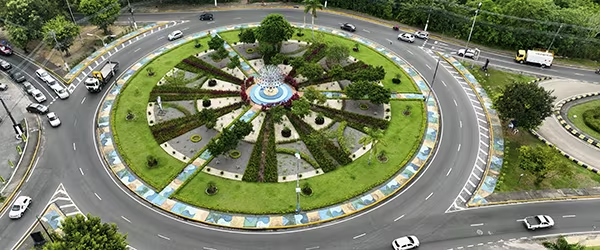
Beyond safety, roundabouts offer additional benefits. Their central islands provide an opportunity for aesthetic enhancements, allowing communities to express their character through sculpted landscapes or eye-catching signage. The most famous is the Arc de Triomphe Roundabout in Paris, France, but other notable roundabouts attracting tourists include Columbus Circle in New York City, NY; the Putrajaya Roundabout in Putrajaya, Malaysia; and the Selamat Datang Monument in Jakarta, Indonesia.
Lower Lifecycle Costs of Roundabouts
While the initial construction costs of roundabouts can be comparable to those of traditional intersections or slightly higher (due to enhancements to the center island), roundabouts often demonstrate cost-effectiveness over time when considering the entire life cycle, including construction, maintenance, and operational costs as there are no traffic signals requiring electricity, maintenance, and repair due to vehicle collisions.
It’s important to note that the cost-effectiveness of roundabouts goes beyond monetary considerations. Factors such as improved safety, reduced congestion, and potential environmental benefits can contribute to the overall value of roundabouts.
The case for roundabouts extends beyond monetary considerations. The many advantages include safety, reduced congestion, environmental benefits, and even opportunities for community expression, position roundabouts as a roadway design solution improving road safety and enhancing the overall transportation experience. As communities prioritize safety and efficiency, the roundabout emerges as a compelling and sustainable intersection design.