
Designing for Safety, Choice and Connection: The Role of Trauma-Informed Design


By KATHRYN PARKHURST, AIA, NCARB, TiD-B
We often think about buildings in terms of what they need to do: How many people will they serve? How should spaces connect? What materials will perform best? How much will the building cost?
But there is another question architects and designers should be asking:
How will this space make people feel?
That question is at the heart of trauma-informed design.
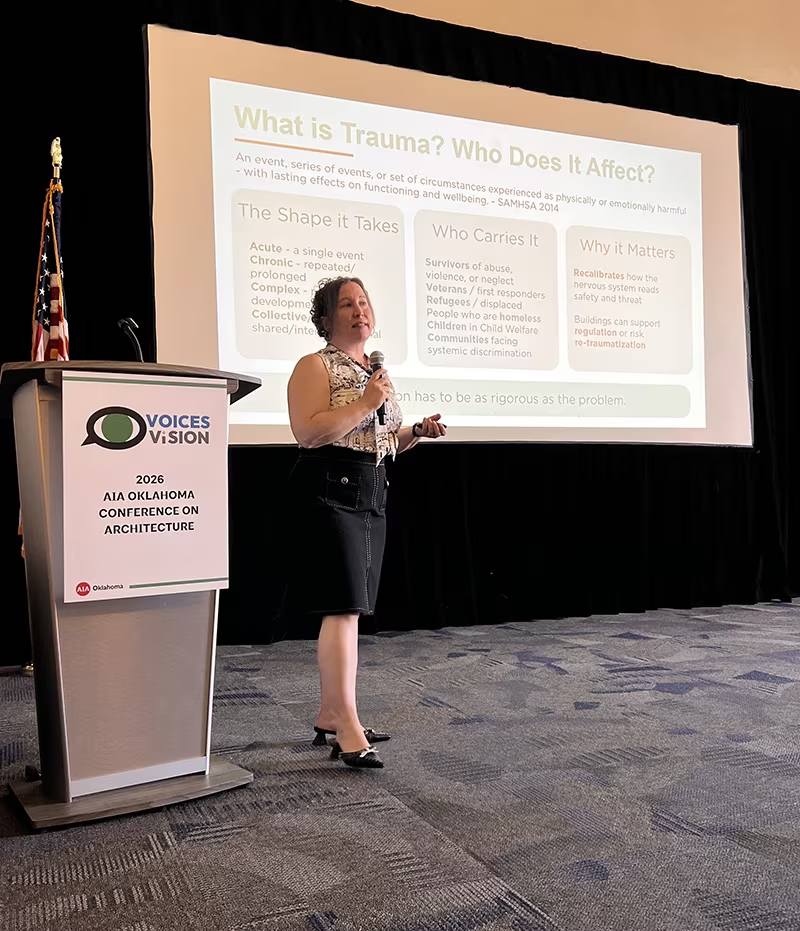
At the 2026 AIA Oklahoma Conference, Guernsey architect Kathryn Parkhurst explored how our understanding of trauma, neuroscience and environmental psychology can influence the way we design the built environment.
Trauma-informed design does not mean designing only for people who have experienced extreme circumstances. Trauma can affect survivors of abuse, veterans, first responders, refugees, people experiencing homelessness and countless others. Chronic stress can also change how people perceive and respond to their surroundings.
And we rarely know who is carrying those experiences when they enter a building.
The Built Environment Can Affect Our Ability to Regulate
One way to understand trauma is through the concept of a window of tolerance.
When we are within that window, we generally feel calm, supported and capable of responding to what is happening around us. Someone with a relatively stable baseline may encounter numerous stressors before becoming overwhelmed.
For someone experiencing chronic stress or trauma, that window may be much narrower. Environmental conditions that seem insignificant to one person may contribute to another person becoming overwhelmed, hyperalert or shutting down.
That means the spaces we create matter.
A confusing entrance, an inability to see an exit, excessive noise, harsh lighting or a lack of personal space can introduce additional stress. Conversely, thoughtful design can provide opportunities for comfort, choice, retreat, movement and connection.
Several established areas of research help explain why.
What Research Tells Us About Space
One foundational study by Roger Ulrich examined hospital patients recovering from surgery. Patients whose rooms provided views of nature experienced better recovery outcomes than those looking at a brick wall, helping establish what would become an important body of research surrounding nature, biophilia, and human well-being.
Attention Restoration Theory by Kaplan and Kaplan takes the idea further. Our brains constantly process information—emails, conversations, deadlines, sounds, screens, and activity. Environments that allow for soft fascination, when our attention shifts away from those demands, can help us mentally and emotionally recover.
That restorative experience does not necessarily require a trip to the mountains or the beach. It might happen while walking through a park, sitting beneath a tree, listening to music in a restorative setting, or occupying a thoughtfully designed interior space.
Another relevant concept is prospect and refuge: our preference for spaces that allow us to see what is happening around us while also providing some sense of enclosure or protection.
Think about entering an unfamiliar room and instinctively choosing a seat where you can see the door. Or consider a child climbing to the top of a playground structure and pausing to survey everything below.
Those behaviors illustrate something important: people continually gather information from their surroundings to determine whether they feel comfortable and safe.
Moving From Theory to Trauma-Informed Design
Trauma-informed design translates these ideas into practical design decisions.
The Trauma-informed Design Society identifies 11 domains that can help guide this work, including safety; trustworthiness and transparency; peer support; collaboration and mutuality; empowerment and voice; choice; equity; community; comfort; movement; and play.
These principles encourage designers to look beyond physical safety alone.
Can people understand where they are going?
Can they choose whether to engage with others or retreat?
Can they see an exit?
Are there different types of spaces for different sensory needs?
Does the environment provide opportunities for connection without requiring it?
Does it reflect the identity and culture of the people who will use it?
Trauma-informed Design isn’t necessarily about adding expensive features. Often, it is about looking at familiar design decisions through a different lens.
A Different Approach to Housing
Kathryn illustrated that process through a developing housing project designed for an especially vulnerable population: individuals transitioning out of homelessness.
An early concept for the site was efficient and straightforward. Homes would have individual driveways, roads would provide circulation around the development, and a central green space would offer a place for residents to gather.
But applying a trauma-informed lens changed the conversation.
Instead of asking only where the houses, roads, and parking should go, the design team began asking broader questions.
What services will residents need? How will they get groceries? Will they need vehicles? Who will come to the property to provide services? What worked—or didn’t work—in the organization’s previous development?
Even policies became part of the discussion.
For example, pets initially were not going to be allowed except when required as service animals. There were legitimate concerns about property damage. But for someone coming out of homelessness, an animal may have been that person’s only consistent companion for months or even years.
That prompted a different conversation: Rather than simply prohibiting pets, could materials and maintenance practices be considered that would make allowing them more feasible?
It is an example of an important lesson: architects can influence more than the physical building. Good questions can help clients think differently about policies, processes, and the people they serve.
Creating Degrees of Privacy and Connection
The revised neighborhood concept moved parking away from the individual homes and created smaller groupings that could establish a sense of neighborhood even as the development was constructed in phases.
Existing mature trees became another opportunity.
Instead of removing them to make room for a playground, the design team considered how the trees could become a destination and a space of restoration—a shaded retreat with seating and string lights connected by a walking path.
The homes themselves were designed to provide different levels of engagement.
Each roughly 300-square-foot home would be identifiable through its own color and potentially through resident-selected names or artwork, giving occupants opportunities to establish identity and ownership.
Front and back doors provide more than circulation. For someone who instinctively scans an environment for exits, knowing there is more than one way out can provide reassurance.
Deep covered porches create a transition between private and communal space. A resident can step outside, observe what is happening, and decide whether to engage rather than moving immediately from the privacy of a home into a fully public environment.
Courtyards, walking paths, gardens, picnic tables, and shared pavilions provide additional levels of connection.
The result is not simply a collection of houses. It is an environment offering choice—including the choice to be alone, to observe, or to participate.
What Architects Can Do Today
We don’t have to wait for the research on the effectiveness of Trauma-informed Design to be complete before asking better questions.
Architects can draw from established environmental and neuroscience research, incorporate the Trauma-informed Design framework, and conduct post-occupancy evaluations to understand how people actually use the spaces we create.
Observation can be particularly revealing.
If a carefully designed seating area is consistently rearranged by its users, for example, that behavior tells us something. Rather than seeing the change as a departure from the design, we can ask why people prefer the new configuration—and what we can learn from it.
Ultimately, Trauma-informed Design is not a checklist or a specialty reserved for one building type.
It is another way of understanding the people for whom we design.
When architects consider safety, choice, comfort, identity, movement, connection, and refuge alongside traditional measures of function and performance, we have an opportunity to create environments that do more than accommodate people.
We can create spaces that help people feel secure enough to choose how they engage with the world around them.
About the Author
Kathryn Parkhurst is an architect with Guernsey whose work explores the intersection of architecture, neuroscience, and human well-being. She has studied trauma-informed design through the Trauma-informed Design Society and is particularly interested in how thoughtful design decisions can create environments that support safety, choice, comfort, and connection.