
What Is Uniform Guidance (2 CFR Part 200) and Why Does It Matter to Federal Grant Recipients?


By Angie Aikman, CIE, CSM, Vice President and Design Group Director, Environmental
Federal grants can fund critical infrastructure, broadband expansion, transportation improvements, water projects, economic development initiatives, and community programs. They also come with a substantial set of requirements that govern how those funds are managed.
Most organizations focus heavily on winning the grant.
Once funding is awarded, the challenge changes.
Procurement requirements, reimbursement requests, financial reporting, documentation standards, subrecipient responsibilities, and audit preparation all become part of project delivery. For many organizations, those responsibilities are distributed across finance staff, project managers, administrators, engineers, consultants, and contractors already balancing numerous other priorities.
For many organizations, these responsibilities are managed by existing staff with support from outside advisors and consultants. Few public agencies, cooperatives, or infrastructure organizations maintain large internal teams dedicated solely to federal grant administration.
The framework governing much of this work is called Uniform Guidance.
Understanding it has become increasingly important as federal agencies place greater emphasis on accountability, documentation, and administrative processes.
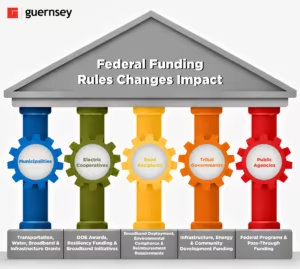
What Is Uniform Guidance?
Uniform Guidance is the federal government’s government-wide framework for managing grants, cooperative agreements, and other forms of federal financial assistance.
Formally known as 2 CFR Part 200, Uniform Guidance establishes requirements related to:
- Administrative requirements
- Financial management systems
- Procurement standards
- Cost principles
- Subrecipient responsibilities
- Record retention
- Audit requirements
In practical terms, Uniform Guidance establishes the requirements for federal grant administration and post-award grant management.
The Office of Management and Budget, commonly known as OMB, originally issued Uniform Guidance in 2013 to consolidate numerous federal grant requirements into a single framework. The regulations became effective in December 2014 and continue to govern most federal financial assistance today.1
In practical terms, Uniform Guidance is the rulebook for managing federal funds.
Who Must Follow Uniform Guidance?
Uniform Guidance applies broadly across the federal grant landscape.
Organizations that may be subject to its requirements include:
- State agencies
- Cities and counties
- Tribal governments
- Special districts
- Nonprofit organizations
- Educational institutions
- Utilities and electric cooperatives receiving federal assistance
- Organizations receiving federal funds through another entity as a subrecipient
One common misconception is that the requirements only apply to organizations receiving money directly from a federal agency.
That is not always the case.
Subrecipients frequently become subject to many of the same requirements that apply to direct recipients.2
Why Uniform Guidance Matters
Winning a grant does not eliminate risk.
It often creates new responsibilities.
Organizations that do not understand applicable requirements can encounter:
- Delayed reimbursements
- Questioned costs
- Procurement findings
- Additional monitoring
- Audit findings
- Increased administrative burden
- Potential loss of funding
Strong grant administration practices have become an operational necessity rather than an administrative afterthought.
Most compliance problems do not begin with major mistakes. They often begin with small documentation gaps, unclear responsibilities, or processes that were never fully defined. Those issues can compound over time until reimbursement requests are delayed, agency questions arise, or staff spend significant time reconstructing records that should have existed from the beginning.
As federal funding opportunities have increased in recent years, so has the government’s focus on how recipients manage those funds.
The Requirements That Often Matter Most
Financial Management Systems
Uniform Guidance requires recipients to maintain financial systems capable of identifying federal awards, tracking expenditures, producing accurate reports, and maintaining supporting documentation.3
The ability to account for federal funds separately and accurately is foundational to grant administration.
Internal Controls
Recipients are expected to establish and maintain effective internal controls that provide reasonable assurance they are managing federal awards in compliance with applicable requirements.4
Internal controls are intended to help prevent fraud, reduce errors, and improve accountability.
Procurement Requirements
Procurement requirements are frequently one of the most challenging areas of federal grant compliance.
Uniform Guidance establishes requirements related to competition, documentation, conflicts of interest, and certain contract provisions.5
A procurement mistake made early in a project can create compliance issues long after contracts have been awarded.
Compliance issues are not always the result of significant errors. In many cases, they develop gradually as documentation requirements, procurement records, environmental coordination, and project decisions become dispersed across multiple departments, consultants, or project files.
Allowable Costs
Not every project expense is automatically reimbursable.
Generally, costs charged to a federal award must be necessary, reasonable, allocable, consistently treated, and adequately documented.6
Documentation gaps often do not become apparent until reimbursement requests are prepared, agency questions arise, or records are needed months or years after the work was performed.
Subrecipient Responsibilities
Organizations that pass federal funds to other entities may have additional responsibilities.
Uniform Guidance requires pass-through entities to evaluate risk, monitor subrecipient activities, and address identified deficiencies when necessary.7
Organizations that pass federal funds to subrecipients may need formal processes to document oversight responsibilities and maintain compliance with federal requirements.
Record Retention and Audits
Federal grant files often must be retained for several years after project closeout.8
Organizations that expend federal funds above applicable thresholds may also become subject to Single Audit requirements.9
The ability to demonstrate compliance frequently depends on records that were created throughout the life of the project.
Why This Matters More Today
Uniform Guidance continues to evolve.
In 2024, OMB finalized significant revisions affecting numerous areas of federal grant administration, including procurement thresholds, indirect costs, equipment definitions, and audit requirements.10
More recently, on May 29, 2026, OMB published another proposed rule that could further revise the federal government’s grant management framework.11
The proposal suggests a continued emphasis on:
- Increased oversight
- More documented accountability
- Greater focus on systems and processes
- More structured monitoring requirements
The proposal is not final and could change during the rulemaking process. However, it provides an important indication of where federal grant administration may be heading.
Federal agencies appear to be placing greater emphasis not only on whether a project is worthwhile, but also on whether recipients have established the systems, documentation practices, and internal processes necessary to manage federal funds responsibly.
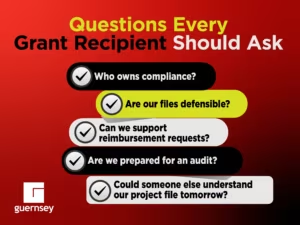
Questions Every Grant Recipient Should Ask
- Who owns grant compliance responsibilities?
- Are our policies and procedures current?
- Are our project files organized and defensible?
- Can we support every reimbursement request with documentation?
- Have environmental and regulatory requirements been fully coordinated?
- If key staff left tomorrow, could someone else understand the project file?
- Do we have processes that support compliance throughout project delivery?
These questions are not theoretical.
They often determine whether a project moves forward smoothly or becomes difficult to administer after funding is awarded.
Looking Ahead
Uniform Guidance is more than a collection of federal regulations.
It is the framework that governs how federal funding is managed from award through closeout.
Federal funding creates opportunity. It also changes the rules under which projects operate.
Organizations that recognize those changes early are often better positioned to maintain stronger schedules, organized documentation, and fewer administrative surprises.
Organizations do not need large internal teams dedicated solely to grant administration to manage federal funding successfully. They do need clear responsibilities, organized documentation, and processes that support compliance throughout project delivery.
Organizations receiving federal funding should evaluate whether their current administrative processes are sufficient before project activity accelerates.
The challenge is rarely the infrastructure itself.
The challenge is building the systems and processes necessary to support it.
About the Author
Angela Aikman serves as Vice President and Director of Environmental Services at Guernsey, where she also leads the firm’s growing Grant Administration Services practice. With more than 25 years of experience managing environmental compliance, federal permitting, and complex infrastructure projects, she has helped public agencies, Tribal governments, utilities, and private organizations navigate the regulatory and administrative requirements that accompany federally funded projects. Her work spans environmental planning, agency coordination, compliance management, and grant-supported project delivery, giving her a practical understanding of the challenges organizations face after funding is awarded.
Notes:
- Office of Management and Budget, Uniform Administrative Requirements, Cost Principles, and Audit Requirements for Federal Awards, 2 CFR Part 200
- 2 CFR §200.101, Applicability
- 2 CFR §200.302, Financial Management
- 2 CFR §200.303, Internal Controls
- 2 CFR §§200.317-200.327, Procurement Standards
- 2 CFR Subpart E, Cost Principles
- 2 CFR §200.332, Requirements for Pass-Through Entities
- 2 CFR §200.334, Retention Requirements for Records
- 2 CFR Subpart F, Audit Requirements
- Office of Management and Budget, Guidance for Federal Financial Assistance, Final Rule, April 2024
- Office of Management and Budget, Regulation for Federal Financial Assistance, Federal Register, Vol. 91, No. 103, May 29, 2026