Five Lessons Universities Can Learn from Long-Term Utility Planning
What Three Decades and Nearly 600 Utility System Evaluations Have Taught Us About Infrastructure, Growth, Reliability, and Stewardship


Campus utility systems are too important and too expensive to manage one project at a time.
After evaluating nearly 600 utility systems over the past three decades, Guernsey’s Energy & Utility Solutions team has learned that the biggest challenges facing universities are rarely technical. They are decision challenges. Infrastructure assets expected to serve generations are often evaluated one project, one budget cycle, and one immediate need at a time.
As Ashish Agrawal, PhD, CEM, CEA, CDSM, CMVP, Executive Vice President and Director of Energy & Utility Solutions, explains: “We help our clients avoid future costs by providing a path forward. Effective utility planning requires both technical and economic expertise.”
Long-term utility planning provides a different perspective. Current work for the University of Oklahoma includes chilled water master planning, chilled water distribution modeling, steam master planning, steam distribution modeling, and electrical master planning. Those efforts build upon decades of work supporting higher education institutions across the country and reinforce several lessons that continue to emerge regardless of campus size or location.
1. Think in Systems, Not Projects
Universities are systems. Their utility infrastructure should be evaluated accordingly.
A chiller replacement affects pumping requirements. Building expansion influences electrical loads. Steam system decisions impact reliability, energy consumption, and future capital requirements. Individual projects rarely operate in isolation.
At the United States Military Academy at West Point, Guernsey developed a utility master plan and thermal energy model evaluating four alternative approaches for serving campus heating needs. The study examined steam systems, hot water systems, natural gas systems, fuel storage, on-post generation, energy security, resiliency, and the unique scheduling requirements associated with higher education institutions.
The assignment was not simply to replace equipment. It was to understand how multiple systems interact and how decisions made today would affect future projects, timelines, and campus operations.
Current work at the University of Oklahoma reflects this same systems approach. Chilled water distribution modeling, steam master planning, and electrical master planning are evaluated together because optimizing one component independently does not necessarily optimize the campus.
The lesson: Universities do not optimize projects. They optimize systems.
2. Evaluate Decisions Over Decades, Not Budget Cycles
Budgets operate in years. Infrastructure operates in decades.
Boilers, chillers, underground distribution systems, and electrical infrastructure often serve campuses for forty years or more. Decisions affecting those assets should reflect their useful life rather than the length of an annual budget cycle.
At the University of Alabama, Guernsey developed a fifty-year renewal and replacement program for thermal, electrical, and natural gas systems. Major maintenance activities, replacement schedules, operations forecasts, and lifecycle costs were combined to help the university better understand future obligations.
As an extension of the study, an energy forecast model was developed to identify future utility demands and determine how much campus growth would require additional chillers, boilers, electrical feeder upgrades, and substation additions. The model evaluated conditions at both the district and campus levels, helping the university understand how future growth would affect utility infrastructure.
Current planning efforts at the University of Oklahoma continue this long-term perspective by examining future capacity and infrastructure requirements rather than focusing solely on immediate projects.
The lesson: Infrastructure should be evaluated over asset lives, not budget cycles.
3. Lowest First Cost Does Not Always Mean Lowest Lifecycle Cost
The least expensive option today may not be the least expensive option over the asset lives.
At West Point, four heating alternatives were evaluated. Each option considered capital costs, financing costs, operations and maintenance expenses, fuel costs, energy security requirements, resiliency, environmental impacts, and operational considerations.
The lesson was not that decentralization (or building level heat) is always the right answer.
The lesson was that the answer emerged only after evaluating capital costs, operating costs, fuel costs, resiliency requirements, financing mechanisms, and long-term operational impacts.
Similarly, work at the University of Alabama combined maintenance requirements, replacement schedules, and operating forecasts into a fifty-year lifecycle analysis. Understanding the total cost of ownership helped the university evaluate future investments with a clearer understanding of their long-term consequences.
Current modeling efforts at the University of Oklahoma help ensure that decisions made today support future demands and avoid unnecessary costs later.
The lesson: Lowest first cost and lowest lifecycle cost rarely result in the same outcome.
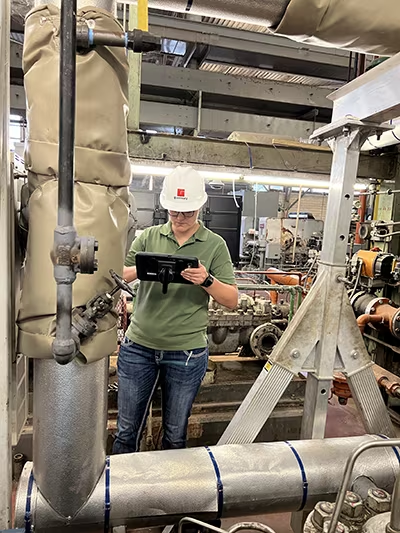
a utility system at the University of Oklahoma
4. Reliability and Resiliency Support the Campus Mission
Utility systems exist to support the mission of the institution.
Students, faculty, researchers, staff, alumni, and visitors depend on reliable infrastructure every day. Residence halls, classrooms, laboratories, athletic facilities, and research spaces all rely on systems that many people never see.
Reliability is not simply an engineering issue.
It is an educational issue.
Universities operate on academic calendars, research schedules, athletic events, and residential life. Unlike many industrial facilities, campuses cannot simply suspend operations when utility systems require attention. Residence halls remain occupied. Laboratories continue operating. Research projects cannot always be interrupted. Athletic facilities, dining halls, and classrooms continue serving students and faculty.
At the University of Oklahoma, Guernsey updated the chilled water hydraulic model using design loads, metered data, and interviews with operations personnel to evaluate load diversification and determine firm capacity requirements. Existing configurations, recent construction, pipe sizing, and known bottlenecks were incorporated into the analysis.
West Point’s evaluation recognized similar challenges. Project sequencing, energy security, resiliency requirements, and scheduling constraints unique to higher education all influenced future decisions.
Reliable infrastructure allows universities to focus on education, research, and service rather than responding to utility emergencies.
The lesson: Reliability and resiliency support the institution’s mission.
5. Stewardship Requires Maximizing Long-Lived Assets
Universities are stewards of resources entrusted to them.
Those resources include tuition dollars, state appropriations, research funding, bond proceeds, and philanthropic contributions. Good stewardship means maximizing the value of infrastructure assets expected to serve generations.
At the University of Oklahoma, Guernsey evaluated the university’s non-potable water system and developed recommendations for replacement and renewal of system components. Data was captured and organized to support implementation of a preventive maintenance program designed to help assets remain in operation for their full useful lives.
The analysis provided a prioritized capital investment strategy and helped the university focus future capital deployment.
At the University of Alabama, utility rate development incorporated projected energy costs, inflation assumptions, commodity forecasts, and capital expenditures. The result was not simply a cost study. It was a framework for understanding the long-term consequences of infrastructure decisions.
Stewardship is not about spending the least amount of money.
It is about spending money wisely and, in often cases, investing in the future.
The lesson: Stewardship means maximizing the value of long-lived assets.
Looking Ahead
Universities change.
Facilities expand. Research priorities evolve. Student populations shift. New technologies emerge. Utility systems must adapt accordingly.
Good utility planning preserves options.
It recognizes that infrastructure decisions affect future flexibility, reliability, and cost long after current administrators, facilities directors, and capital programs have changed.
As Ashish Agrawal explains: “The goal of long-term utility planning is not to produce reports. It is to provide institutions with a path forward and help them make better decisions.”
After evaluating nearly 600 utility systems over the past three decades, one lesson stands above the rest:
Universities are systems, and utility decisions should be evaluated accordingly.
Long-term utility planning helps institutions understand those relationships, focus capital deployment, and make decisions that continue serving students, faculty, researchers, and future generations long after today’s projects are complete.